Single Screw and Twin Screw Extruders | Technovel
The difference between single screw and twin screw extruders is not limited to the number of screws. They differ in conveying and propulsion principles, self cleaning, extrusion stability, and material feeding. Regarding the conveying and transport principle, single screw extruders and corotating twin screw extruders move material forward through friction, based on the principle of a right hand screw and nut. In corotating twin screw extruders, the screws intermesh with each other, and the wiping effect provides self cleaning that conveys material efficiently. In counterrotating twin screw extruders, the calendering effect forcibly drives material forward. These extruders adopt different feeding methods to achieve stable supply and conveyance of the material.
Conveying and Propulsion Principles

The Right Hand Screw and Nut Principle
In single screw extruders and corotating twin screw extruders, the forward conveyance of solid material can be explained by analogy with a nut threaded onto a right hand screw. When the bolt is rotated while the nut is held in place by hand, the nut moves forward along the bolt. In this analogy, the extruder screw corresponds to the bolt, and the plastic material corresponds to the nut. Inside the extruder, the force that holds the nut and prevents it from rotating corresponds to the friction between the plastic material and the extruder. Through this friction, the plastic material is anchored against the inner wall of the barrel, and the rotation of the screw pushes it forward. This process conveys the plastic material along the screw and advances it to the next processing stage.
Forward Conveyance by Wiping
In the case of corotating twin screw extruders in particular, self cleaning by wiping occurs in the fully intermeshing region, where the screws scrape material off each other. As a result, the material does not corotate with a single screw but is conveyed forward. Stagnation of material is minimized, and conveyance proceeds efficiently.
Calendering Effect
In counterrotating twin screw extruders, the screw flights of one shaft are filled by the flights of the other due to the structural arrangement. Material is therefore conveyed forward by a principle similar to that of calender rolls or a gear pump. Owing to this mechanical structure, the material is forcibly and powerfully driven forward.
Self Cleaning Effect
Self Cleaning in Corotating Twin Screw Extruders
The self cleaning effect of twin screw extruders is one of their important benefits. It minimizes the stagnation of material and enables efficient conveyance and compounding. Product quality stability improves, and contamination and material residue inside the machine are reduced.
In corotating twin screw extruders in particular, the screws are designed to intermesh, which prevents material from clogging or accumulating in the screw flights. As the meshing screws rotate, material is transferred continuously from one screw to the other, and this is the mechanism that produces the self cleaning effect. Material around the screws is kept in constant motion, and stagnation rarely occurs.
Extrusion Stability

Extrusion Stability of Single Screw Extruders
Single screw extruders show relatively stable pressure and throughput, which depends on the flowability of the material and the design of the screw. Depending on the material and the operating conditions, however, pressure can fluctuate, and stability may be compromised in such cases.
Extrusion Stability of Twin Screw Extruders
In twin screw extruders, a gear pump is sometimes required to stabilize the throughput at high precision. When highly accurate metered extrusion is required in particular, a gear pump makes it possible to control pressure and throughput.
Devolatilization Performance

Twin screw extruders show better devolatilization efficiency than single screw extruders for several reasons. The strong compounding action between the screws heats the material uniformly, and the large surface area generated promotes efficient evaporation of volatile components. In addition, the flexibility of screw configuration allows optimal placement of devolatilization zones, which removes volatile components efficiently.
Material Feeding

In single screw extruders, the solid conveying section is fully filled with material, so plastic is usually supplied directly to the hopper without using a feeder. In twin screw extruders, by contrast, the feeding process requires the use of a feeder for material supply.
Other Characteristics of Twin Screw Extruders
High Compounding Capability, Suited to Mixing Multiple Materials
The two screws interact with each other as they move the material, so they compound the material efficiently and achieve dispersive and distributive mixing. This gives them excellent capability to blend multiple materials uniformly. Composite materials and nanomaterials are compounded homogeneously, and high quality mixtures are obtained.
High Shear Stress
The design and arrangement of the screws allow strong shear to be applied to the material, so even highly viscous materials and materials that are difficult to melt can be processed efficiently. This is used especially for reactive extrusion and resin compounding.
Material Can Be Added Midway Through the Process (Side Feeding and Liquid Injection)
Solid materials and liquids can be added partway through the extrusion process. With side feeding, for example, materials can be introduced at different stages, and a twin screw extruder makes it possible to compound multiple materials efficiently. Liquid addition is also possible in the same way, and adding additives, lubricants, or reactive agents at the optimal point in the process achieves specific product properties.
Differences by Screw Rotation Direction in Twin Screw Extruders
In corotating twin screw extruders, shear between the screws is large, and compounding is performed powerfully. They are excellent when uniform mixing of complex materials or high compounding performance is required. Counterrotating twin screw extruders apply less shear than corotating types and impose less stress on the material, which makes them suitable for processing materials where shear heating must be avoided. They are suited to the processing of materials such as PVC where shear heating must be avoided, and are used in particular for applications that call for stable extrusion at low speed.
*For more details, please also refer to the explanatory page “Differences Between Co rotating and Counter rotating“.
Related Extrusion Columns
Extrusion Technology Roadmap
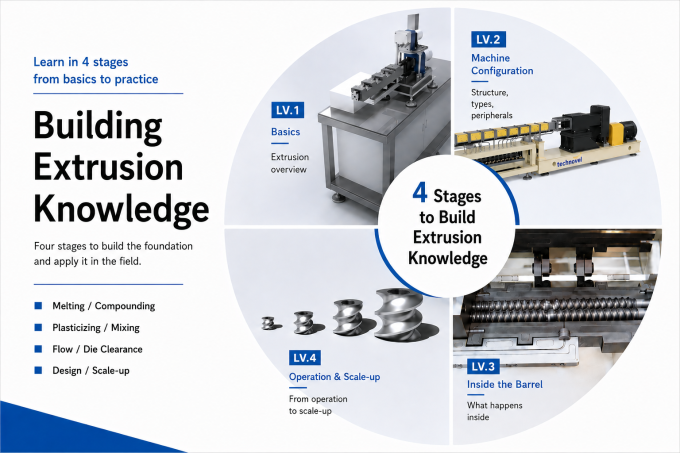
All 13 articles organized into 4 stages (basic concepts / machine configuration / internal phenomena / practical applications)
ABOUT THE PUBLISHER
Technovel Corporation — Extrusion Machinery Specialists
Osaka based Technovel specializes in extrusion machinery. We built the world’s first horizontally multi screw extruder, and our Quad and Octa screw extruders now serve diverse industries. Our twin screw range runs from the world’s smallest 6 mm lab unit, through our best-selling 15 mm model, to large production machines. This column shares the know how behind them.