Fill Factor (Q/N) and Residence Time | Technovel
Introduction
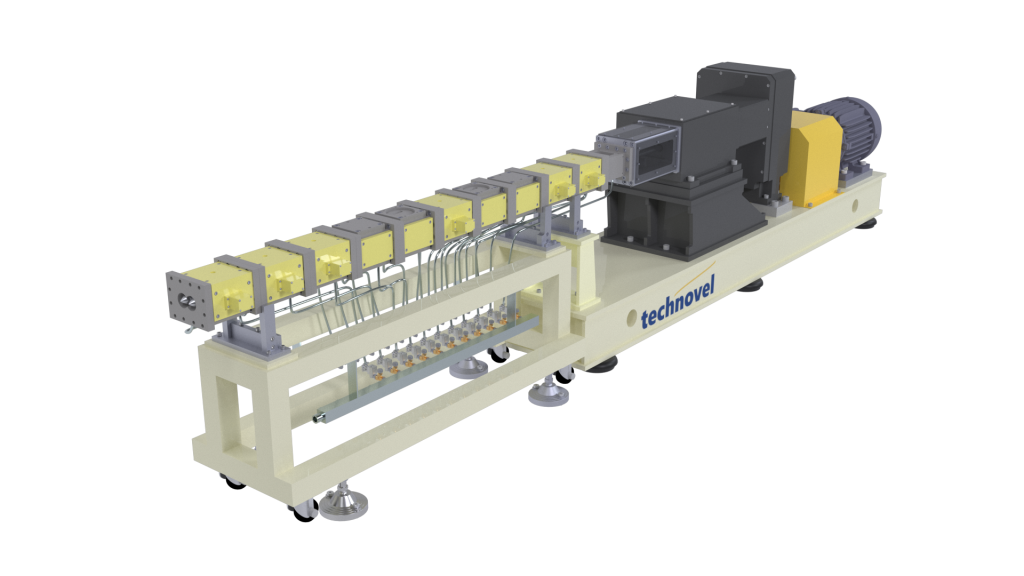
In twin screw extruders, the screw configuration itself often draws the most attention. What actually governs the real process behavior, however, is how the material flows inside the extruder in terms of its degree of fill. Even with the same screw formation, a change in throughput or screw speed alone can substantially alter how the resin flows, how long it resides in the barrel, and how shear is applied.
On the shop floor, problems such as unstable mixing, melt temperatures climbing higher than expected, or vent up during devolatilization frequently trace back to issues of fill ratio. Fill ratio is not simply a matter of “higher is better” or “lower is better.” In real extrusion processes, the question of how to build the right fill state according to material properties and process objectives is what matters.
One of the interesting aspects of twin screw extruders is that the internal filled regions can be designed with some intent through the screw formation. By adjusting operating conditions such as throughput and screw speed, the fill state and residence behavior can also be shifted significantly even with the same screw configuration.
This page organizes the basic thinking around fill ratio in twin screw extruders and how Q/N, an indicator of the fill state, influences the internal filling behavior of the extruder. Drawing on observations from actual machines, the content is presented in a way that aims to make the phenomena inside the extruder intuitive to grasp.
Fill ratio and Q/N in twin screw extruders
What fill ratio means
Fill ratio is an indicator of how much material occupies the screw channels. It is generally expressed in a range from 0 to 1 and serves as the basic measure of how densely material exists inside the extruder.
Q : actual throughput, Qmax : theoretical maximum throughput
What Q/N means
Q/N (output rate / screw speed) is an index used to evaluate the degree of fill inside the extruder. At a given screw speed, a higher output rate results in a higher fill ratio; at a given output rate, increasing the screw speed lowers it. In practice, Q/N serves as a quick reference for estimating how full the machine is.
C : volumetric coefficient of the barrel and screw (a constant that depends on screw size and element design)
This proportional relationship holds in partially filled conveying sections, where the material does not completely fill the screw channel. Note that the fill ratio is not a single uniform value throughout the extruder; it varies along the process. Along the screw, partially filled sections (η < 1) coexist with fully filled sections (η = 1), such as kneading blocks and the zone just upstream of the die. Since the latter are already full, changing Q/N does not affect their fill ratio. For this reason, the average fill ratio of the machine as a whole is not strictly proportional to Q/N.
Also note that while the same Q/N produces nearly the same fill state in the partially filled sections, it does not mean the residence time or shear history will be the same. Even at the same Q/N, doubling the screw speed roughly halves the time the material takes to pass through the machine.
Fill state in the extrusion process

The fill state inside the extruder shifts significantly with the screw formation. Full flight screws, which carry strong conveying capability, push material forward easily and tend toward relatively low fill. Combining reverse flight elements or elements without conveying capability allows material to accumulate and creates highly filled regions.
In real twin screw extrusion, the overall flow is designed by deliberately creating places where material is pushed in and places where it can escape. Engineers raise the fill in zones where stronger mixing is needed and lower the fill in devolatilization zones so that a free surface is available. The point is not whether high or low fill is good, but rather what kind of state the designer wants to create at each location.
Effects of fill ratio
Achieving uniform mixing and dispersion
Under high fill conditions, material elements inside the screws are pressed firmly against each other, which raises shear stress and promotes both dispersive and distributive mixing. This works particularly well for compounds where fillers, pigments, or additives must be evenly distributed. Excessive fill, however, leads to higher pressure and greater viscous heating, which can drive resin temperatures up, cause thermal degradation, and increase the load on the machine. When fill ratio is extremely low, voids inside the screws grow and the shearing action weakens, so insufficient mixing and poor dispersion tend to occur.
Product uniformity and process stability
When an appropriate fill ratio is maintained, the flow inside the extruder stabilizes and the variations in throughput and pressure stay small, which supports consistent product quality. For high viscosity resins and highly filled materials, fluctuations in the fill ratio can directly affect product quality. When the fill state is unstable, pressure pulsation, air entrainment, and throughput variation tend to occur, which may degrade dimensional accuracy and surface quality.
Fill ratio and residence time
Residence time refers to how long material spends in the extruder from the point of feed to the point of discharge. In general, the higher the fill ratio, the greater the amount of material present inside the extruder at any moment, so residence time tends to grow longer.
Under high fill conditions, material is exposed to shear for a longer time, which makes it easier to improve mixing and uniformity. Thermal history also increases, so for heat sensitive materials, degradation and loss of properties can become problems. Under low fill conditions, residence time is short and thermal history stays low, but insufficient mixing or dispersion may occur. For this reason, residence time and fill ratio cannot be considered in isolation, and both must be optimized together.
Effect of fill ratio on residence time
When the fill ratio is high, residence time becomes longer. More shear stress acts on the material, mixing advances, and mixing quality improves. Excessively long residence time, however, can cause decomposition or degradation, especially for heat sensitive materials. When the fill ratio is low, residence time shortens and material passes quickly through the screws. In such cases, mixing and dispersion may turn out to be insufficient.
Effect on chemical reactions
In reactive extrusion processes, fill ratio directly affects reaction efficiency. Under high fill conditions, residence time grows longer and it becomes easier to secure the reaction time required, but viscous heating and local overheating may turn into problems. Under conditions where fill ratio is too low, material passes through quickly and the reaction does not have enough time to proceed, which can lower the conversion rate. Reactive extrusion therefore calls for designing an appropriate fill ratio while considering residence time, mixing, and temperature history together.
Basic experiments with the ULTnano15
How screw speed and throughput affect fill ratio

To visually confirm how changes in the Q/N indicator shift the fill ratio, experiments were performed using a compact twin screw kneading extruder. The equipment used was the ULTnano15 , a compact recirculating twin screw kneading extruder, though the recirculation path was not used. Continuous extrusion was performed in a single pass arrangement, since the focus was on observing the fill state of the plastication and melting zone in the early part of the extrusion process.
On the same machine, Q/N was adjusted by varying operating conditions such as screw speed and throughput, and the resulting effect on the fill state was checked visually. A special split barrel design was used, which made it possible to visualize the fill state during operation with high repeatability, even compared with methods that confirm the fill state by pulling the screws out.
Experimental overview
Test equipment: ULTnano15 compact recirculating twin screw extruder
Screw diameter: 15 mm
L/D: 15, single pass arrangement
Screw speed: 1000 rpm
Feed material: ENEOS NUC DFDJ-0964
Temperature settings: C1 : 120 °C, C2 and D : 160 °C
Screw speed and throughput: varied by sample
* A melt temperature and pressure sensor was installed at the discharge section.
Operating conditions / screw speed, throughput, and Q/N
| ① | ② | ③ | ④ | ⑤ | ⑥ | ⑦ | ⑧ | ⑨ | |
| Throughput g/hr | 500 | 2500 | 5000 | 1500 | 1500 | 1500 | 300 | 1500 | 3000 |
| Screw speed rpm | 100 | 500 | 1000 | 100 | 500 | 1000 | 300 | 300 | 300 |
| Q/N | 5C | 5C | 5C | 15C | 3C | 1.5C | 1C | 5C | 10C |
Comparison of ①/②/③: differences in fill ratio across three points at the same Q/N
Comparison of ④/⑤/⑥: differences in fill ratio across three points at different Q/N (throughput held constant)
Comparison of ⑦/⑧/⑨: differences in fill ratio across three points at different Q/N (screw speed held constant)
Operating conditions / screw formation

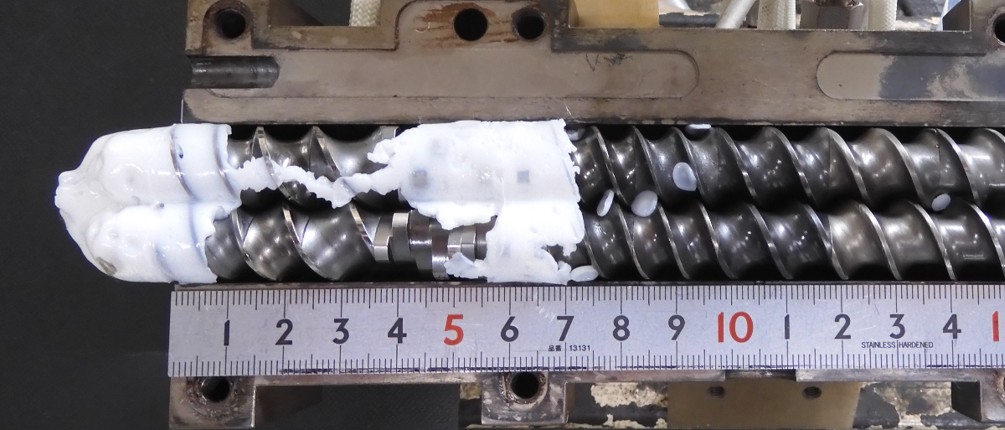
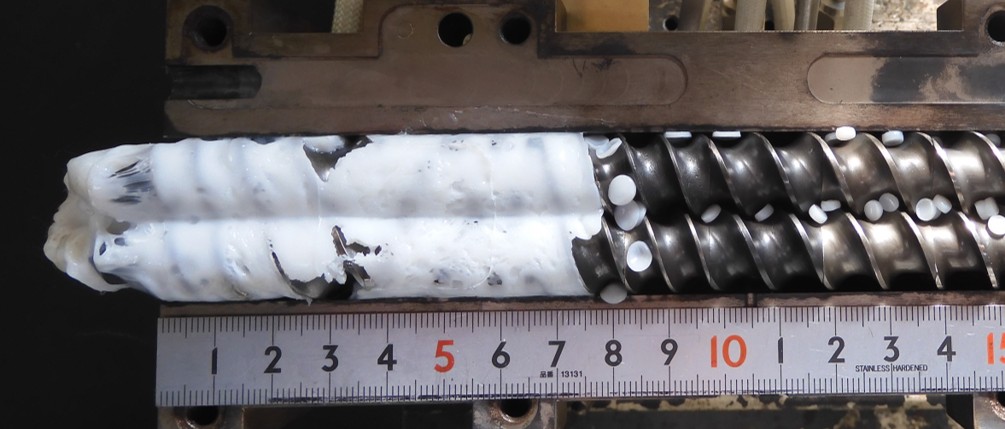
Visual comparison at the same Q/N (①/②/③)


Visual comparison at different Q/N (④/⑤/⑥), throughput held constant


Visual comparison at different Q/N (⑦/⑧/⑨), screw speed held constant

Experimental results
When compared at the same Q/N, the fill ratio showed no significant difference, apart from minor variations. In contrast, comparisons at different Q/N values revealed clear differences, with higher Q/N consistently producing a higher average fill ratio inside the extruder. These results show that the balance between feed rate and screw speed has a sensitive effect on the residence behavior and fill state of the resin, supporting the validity of Q/N as a process parameter.
The slight differences observed among conditions ①, ②, and ③ (same Q/N) are presumably due to the absolute throughput affecting the pressure at the die, the melt temperature, and the viscosity of the material. Also note that while ①, ②, and ③ show an equivalent fill state, their screw speeds differ by a factor of ten, which means factors such as residence time and shear history differ substantially. This is also reflected in the differences in the melt temperature and pressure data measured at the discharge end. The effects of operating conditions on temperature and pressure are discussed on a separate page.
※ For more details, please also refer to the explanatory page “Practical organization of operating conditions in twin screw extruders“.
Relationship between fill ratio and screw formation
Fill ratio and residence time are key process indicators that ultimately affect final product quality. However, the two do not correspond one-to-one: a high fill state created by screw configuration or by lowering the screw speed extends the residence time, whereas a high fill state resulting from an increased output rate actually shortens it. Neither is inherently better — what matters is designing the process with an awareness of which operating lever is used to create the desired fill state for the intended compounding performance. Q/N is a useful index for organizing fill conditions and building a systematic understanding of operating conditions.
※ For more details, please also refer to the explanatory page “Screws and screw formations in twin screw extruders“.
Importance of fill ratio design: other effects
Fill ratio influences not only devolatilization but also temperature history, mixing state, fiber breakage, and dispersion, all of which shape overall product quality. Under high fill conditions, shear stress and pressure rise, so dispersion performance tends to improve, but viscous heating also grows, which raises the risk of thermal decomposition and reduction in molecular weight. For glass fiber and carbon fiber materials in particular, excessive shear can lead to a drop in fiber length. Under low fill conditions, internal heat generation stays low and temperature control becomes easier, but mixing force tends to be insufficient. The result can be poor dispersion and unstable discharge.
A clear tradeoff exists in fill ratio design, and optimal conditions need to be determined by considering material properties, quality requirements, and machine load together.
Summary
Fill ratio and residence time in twin screw extruders are important process indicators that affect the mixing state, shear history, devolatilization performance, and even the quality of the final product. In general, high fill conditions extend residence time and work in favor of mixing and reaction, but they also raise the risk of temperature rise and thermal degradation. Low fill conditions keep thermal history low but can lead to insufficient mixing or dispersion.
For this reason, the twin screw extrusion process is not a simple choice between high fill and low fill. The right approach is to design the optimal fill state according to the target mixing performance, reactivity, and quality requirements. Q/N is an effective parameter for organizing that fill state and for systematically understanding operating conditions, and it proves highly useful in practice as well.
Related extrusion columns
Extrusion technology roadmap

All 13 articles organized into 4 stages (basic concepts / machine configuration / internal phenomena / practical applications)
ABOUT THE PUBLISHER
Technovel Corporation — Extrusion Machinery Specialists
Osaka based Technovel specializes in extrusion machinery. We built the world’s first horizontally multi screw extruder, and our Quad and Octa screw extruders now serve diverse industries. Our twin screw range runs from the world’s smallest 6 mm lab unit, through our best-selling 15 mm model, to large production machines. This column shares the know how behind them.