What is an Extruder? | Technovel
What Is an Extruder
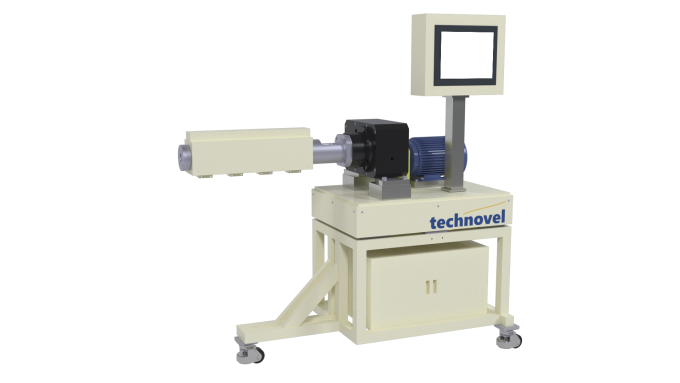
An extruder is a machine that continuously pushes material forward, and it is used to process a wide range of materials including plastics, rubber, food, and metals.
An extruder heats and melts material, then pushes it through a die to form a specific shape. It is one of the plastic forming methods and is used across many fields. The extruder uses a rotating screw to generate high shear stress, allowing it to uniformly compound materials such as rubber and plastics. Because the temperature during compounding can be precisely controlled, melting and chemical reactions of the material are managed with accuracy, supporting plastic forming, food processing, and many other applications. Beyond compounding, the extruder also shapes material into specific forms through a die, which suits it for continuous production of many product types.
The extruder is a type of compounding equipment, designed specifically to perform material compounding effectively. As a compounding device, the extruder mixes different components evenly and homogenizes their physical and chemical properties. The extruder plays a key role as a compounding machine because it shapes material while also transforming the properties of the material itself. When advanced compounding is required for new material development or manufacturing processes, the extruder becomes a very effective tool.
Types of Compounding Equipment

Beyond extruders, there are many other types of compounding equipment. Batch mixers, which handle one load at a time, compound material in fixed quantities. Representative examples include Banbury mixers and kneaders. They are mainly used for compounding rubber and resin. Each device is selected based on its application and on the characteristics of the material being compounded. Extruders excel at continuous compounding, while batch type machines are suited to specific materials and conditions.
Unlike batch type compounding equipment, the extruder feeds material continuously and produces output continuously. This makes it well suited for high volume production and an efficient manufacturing process. It also uses a rotating screw to generate high shear stress, allowing uniform compounding of viscous materials such as rubber and plastics. With controlled temperature, melting and chemical reactions can be managed precisely, supporting a wide range of applications such as plastic forming and food processing. Beyond compounding material, the extruder can also form specific shapes through a die.
Types of Extruders

Extruders are classified by three factors: the number of screws, how the screws intermesh, and the direction of screw rotation. These factors heavily affect the shear force applied to the material along with mixing pattern and residence behavior. They also determine the application fields and the processes at which each extruder excels. For this reason, extruders are generally classified from these three perspectives and selected according to their characteristics.
Classification by Number of Screws
A single screw extruder is easy to operate and low in cost, yet it is not well suited for complex compounding. The twin screw extruder offers strong compounding capability and handles complex mixing and processes, while the multi screw extruder is used when even more advanced processes are required. Because of this superior compounding capability, they are also called twin screw compounding extruders and multi screw compounding extruders.
Classification by Screw Intermeshing
The intermeshing type enables high shear stress, while the non intermeshing type is characterized by gentle mixing.
Classification by Direction of Screw Rotation
Co rotating twin screw extruders suit high shear compounding, while counter rotating twin screw extruders deliver excellent dispersion through a compounding action similar to calendar rolls.
Operating Principle and Process of an Extruder

In a single screw extruder, power from the motor passes through a reducer to a single screw. As the screw rotates inside the barrel, it conveys, melts, and compounds the raw material. Through screw rotation, the material moves forward inside the barrel while shear stress and compressive force are applied. Heaters are attached to the barrel, and temperature control keeps the material properly melted and in a condition suitable for forming. Screw geometry, rotation speed, and barrel temperature all affect extrusion performance and the quality of the final product.
Feeding
Material is supplied from the hopper into the screw. As the screw rotates, the material moves forward.
Heating and Melting
The heaters warm the material inside the barrel, converting it from a solid into a liquid or molten state. Temperature management is critical and must be controlled with precision.
Dispersive and Distributive Mixing
As the screw pushes the material forward, compounding takes place at the same time. The screw configuration improves both dispersive and distributive mixing, and the material properties are optimized.
Extrusion
Finally, the molten material is pushed through a die and shaped into its final form. A cooling system then solidifies the material to produce the finished product.
About the Single Screw Extruder
The single screw extruder has a simple structure and offers strong cost performance, which is why it is widely used across many applications.
Plastic Extrusion Forming
The single screw extruder is well suited to forming common thermoplastic resins such as polyethylene and polypropylene. It is used to make pipes, films, sheets, cable coverings, and profile shapes. In pipe and film production especially, uniform flow rate is achievable, so stable forming quality becomes an important factor.
Recycling and Regeneration
In the plastic recycling process, used plastic material is ground and then regenerated into pellets with a single screw extruder. The efficient processing capacity and continuous operation of the single screw extruder are advantages in the recycling process.
Rubber Extrusion Processing
Single screw extruders are also used in rubber product forming. They are particularly capable of handling viscous rubber materials in the production of automotive sealing materials, hoses, and belts. The material is heated and melted inside the barrel, then pushed out into appropriate shapes to produce a range of rubber products.
Food Processing
In the food industry, single screw extruders are used to make pasta, snack foods, and similar products. Heating, pressurizing, and forming of food materials can all be performed in one pass, which improves the efficiency of the manufacturing process. Single screw extruders play an important role in puffed snack production in particular.
Operating Principle of the Single Screw Extruder

The single screw extruder is a machine that melts solid material and forms it continuously. Its operating principle can be explained across the following three zones.
Feed Zone
The feed zone is the initial stage of the extruder, where raw material is supplied from the hopper into the screw channel. In this zone, the material is simply conveyed without being compressed. The role of the feed zone is to deliver the material reliably into the next compression zone and to maintain stable flow.
Compression Zone
The compression zone is the stage where the material is compressed and gradually melted. In this zone, the screw channel depth decreases progressively and pressure rises. The material receives frictional heat from the compression along with external heat from the heaters, and it enters a molten state. Mixing of the material also takes place here, bringing it to a uniform molten condition.
Metering Zone
The metering zone is the final stage that delivers the molten material to the next forming stage at a uniform flow rate. In this zone, the material is conveyed at a constant screw depth, pressure is stabilized, and temperature is held steady. The role of the metering zone is to supply material consistently so product quality is preserved. These zones work together so the melting and forming process of the single screw extruder as a whole proceeds efficiently.
Screws for the Single Screw Extruder
Single screw extruder screws come in many types, each designed for a specific function or purpose.
Full Flight Screw
This is the standard screw type for extruders, carrying uniform flights (the threaded sections) along the full length of the screw. Its primary role is to convey and melt material. It is suited for cases that do not require compounding or high shear stress. The design is simple, applying even pressure while efficiently pushing the material forward.
Mixing Screw
This screw is specially designed to promote material compounding. The flight geometry is irregular, with many varieties such as Dulmage, pin, and Maddock types, and it includes sections that apply strong shear stress to the material. It is used to homogenize molten plastic, match colors, or evenly disperse additives into the material. A high compounding effect makes it well suited for the mixing of complex materials.
Barrier Screw
This design physically separates molten material from unmelted material and gradually compounds the molten portion. An additional flight called the barrier flight is positioned along the screw. The barrier screw is well suited to high efficiency melting and to cases that require a uniform melt state.
Use of Extruders in the Food Sector
As the name suggests, extrusion forming gets its name from continuously pushing material forward with a screw. The first applications of screw based equipment are said to have appeared in the food sector. Use spread through grape juice presses, soybean oil presses, spaghetti and other pasta makers, and meat grinders. After that, extrusion forming technology developed significantly alongside advances in plastic materials, and it came to be applied to direct forming of films, sheets, fiber spinning, and pipes.
Alternative Meat Including Soy Meat
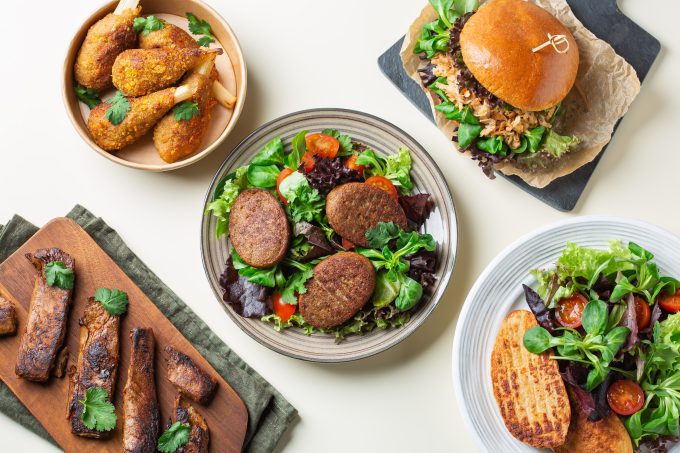
In the extruder industry, the production of soy meat and alternative meat is drawing attention as sustainability and health awareness continue to grow within the food industry. Twin screw extruders are used to produce soy meat and alternative meat. Their effective shear based mixing is particularly useful when creating a texture similar to meat. Precise control of material temperature also allows consistent production of quality alternative meat. A manufacturing process based on the extruder can reproduce the texture and flavor of meat using plant protein.
The extruder processes plant based raw materials, mainly soy and pea protein, under high temperature and high pressure conditions to create a fibrous meat texture. During this process, the protein is denatured, producing a chew similar to that of meat. Growth is expected in the alternative meat market, and innovation in extrusion technology is moving forward with it. Research and development efforts are especially active around environmentally conscious new raw materials and textures that come closer to the natural article.
Related Extrusion Columns
Introducing the Extrusion Technology Roadmap
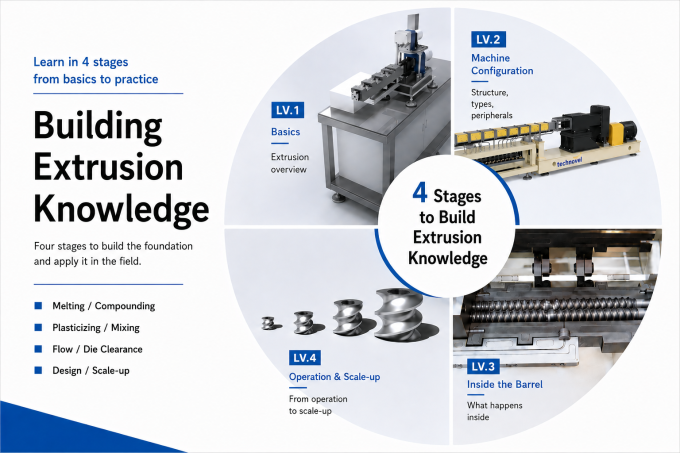
All 13 articles organized into four stages (basic concepts / machine configuration / internal phenomena / practical applications)
ABOUT THE PUBLISHER
Technovel Corporation — Extrusion Machinery Specialists
Osaka based Technovel specializes in extrusion machinery. We built the world’s first horizontally multi screw extruder, and our Quad and Octa screw extruders now serve diverse industries. Our twin screw range runs from the world’s smallest 6 mm lab unit, through our best-selling 15 mm model, to large production machines. This column shares the know how behind them.