Auxiliary Equipment for Twin Screw Extruders | Technovel
Main Auxiliary Equipment for Twin Screw Extruders
Feeder
A feeder supplies raw materials to the extruder in a stable manner. Uniform material feeding has a major impact on extrusion quality, so the feeder plays a critical role. For the material conveying section, options include coil type or screw type, and single shaft or twin shaft configurations. The choice depends on material properties, the required throughput, and the level of stability needed.
1. Gravimetric Feeder
This type meters the material accurately while feeding it at a constant rate. It is mainly used when high precision material control is required.
2. Volumetric Feeder
This type feeds material at a constant volume. The structure is simple and the cost is low, so it is used when relatively low feeding accuracy is acceptable.
3. Side Feeder
This device feeds material into the twin screw extruder from the side. It is mainly used when adding fillers, fibers, or other additives later in the process.
Screen Changer
Material inside the extruder may contain impurities or foreign matter. The screen changer removes these contaminants from the extruded material. Screens or filters are installed, and they catch foreign matter as the material passes through. Some types allow continuous filter replacement, while others require manual replacement at set intervals.
Gear Pump
A gear pump stabilizes material pressure and flow rate during the extrusion process. This makes the forming more uniform and improves product quality. It is especially effective when processing high viscosity materials. Because the gear pump delivers material with precision, forming accuracy at the die head is improved.
Die Head
The die head is the key device that shapes the extruded material into the specified form. The die can be customized according to the product shape and purpose, and many varieties are available.
Cooling System
Extruded material normally comes out at a high temperature, so a cooling system brings the temperature down and stabilizes it. Cooling methods include the following.
1. Water Bath
The extruded material is immersed in water for cooling. This method is often used to cool strands or sheets.
2. Air Cooling Conveyor
This method uses air to cool the material. Temperature control is easier, so it suits applications where the material needs to stay dry.
3. Chill Rollers
These are used mainly for cooling films and sheets. The material is sandwiched between rollers and cooled evenly.
Pelletizer
A pelletizer cuts the extruded material into small granules called pellets. The pellets are processed into a shape and size suited for injection molding or other downstream manufacturing steps. The following pelletizer types are available.
1. Strand Cut Pelletizer
The extruded strands are first cooled and then cut into small pieces by a cutter. This method is used for pelletizing solid materials such as resins.
2. Hot Cut Pelletizer
In this type, the material is cut directly at the die face. It suits high viscosity materials and high throughput operations.
3. Underwater Pelletizer
The material is cut at the die face and immediately cooled in water. This enables highly efficient continuous production.
Vacuum Deaerator
Some resins and other materials release gas or moisture during plasticization. In addition, when powders or materials with low bulk density are compounded, air can be drawn in along with the material. This moisture and gas affects the quality of the molded product. A vacuum deaerator actively draws moisture and gas out of the molten material and improves product quality.
The deaerator consists mainly of a vacuum pump, a vacuum trap, and vacuum piping. The vacuum piping connects to the vent section of the extruder barrel for operation.
Liquid Addition
This device introduces liquid materials into the extruder. The pump type must be selected according to the viscosity of the liquid, the flow rate, and whether heating is required. The liquid addition device consists mainly of a liquid feed pump, a tank, and liquid feed piping. The liquid feed piping connects to the vent section of the extruder barrel for operation. A dedicated plug for liquid feed piping is used at the barrel vent in this case.
Film Take-up/Winding
This device pulls, cools, and winds the sheet shaped material extruded from the tip of a T die into a roll. Material exiting the T die first passes through chill rolls, where it is rapidly cooled and solidified, and is then conveyed by take-up rolls. The conveyed material is then collected into a roll by the winding roll. The material extruded from the T die must be cooled under conditions matched to the resin properties. For this reason, temperature controlled coolant (water or oil) is fed into the chill rolls to keep the roll surface at the appropriate temperature.
Related Extrusion Columns
Extrusion Technology Roadmap
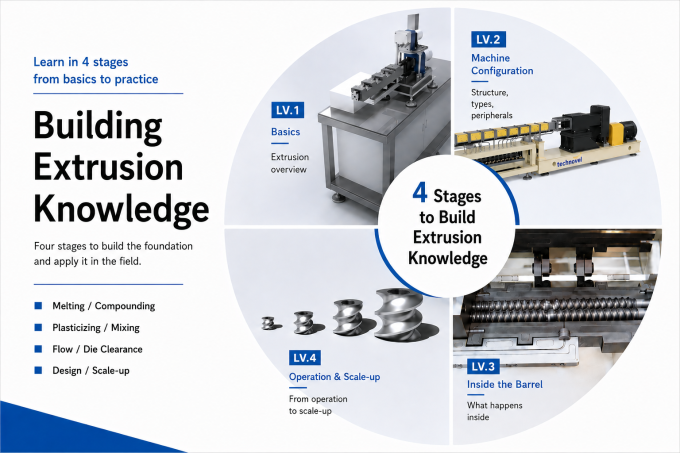
All 13 articles organized into four stages (fundamental concepts / machine configuration / internal phenomena / practical application)
ABOUT THE PUBLISHER
Technovel Corporation — Extrusion Machinery Specialists
Osaka based Technovel specializes in extrusion machinery. We built the world’s first horizontally multi screw extruder, and our Quad and Octa screw extruders now serve diverse industries. Our twin screw range runs from the world’s smallest 6 mm lab unit, through our best-selling 15 mm model, to large production machines. This column shares the know how behind them.